
If an employee becomes unable to work as a result of a leisure activity, the question arises for the employer as to whether there is an obligation to continue paying wages. Whether it be injuries sustained during dangerous sports such as boxing or skydiving, or piercings that become infected, where are the limits of continued pay? Nils Wigger, a solicitor and specialist in employment law at the law firm Wittig Ünalp, explains what the employment tribunals have to say on this matter and what the current trend is.
Employees’ leisure activities are just as varied as the world of work itself. But what if these leisure activities have a negative impact on work? Whether it’s enhancing one’s appearance through cosmetic procedures, tattoos and piercings, or the consequences of a dangerous hobby such as boxing, motocross or ice hockey. The risk of incapacity for work is a constant companion. But what about the employer’s obligation to continue paying wages? Does the employer bear the risk of incapacity for work during leisure time? And where is the line drawn? These questions are not only faced by employers, but are also repeatedly dealt with by the labour courts in Germany.

When is an employer obliged to continue paying wages?
In principle, section 3(1), first sentence, of the EntgFG establishes the employer’s obligation to continue paying remuneration in the event of illness. It states:
“If an employee is prevented from performing their duties due to incapacity for work resulting from illness, through no fault of their own, they are entitled to continued payment of remuneration
the event of illness by the employer for the period of incapacity for work up to a maximum of six weeks.”
As every rule has an exception, the legislator also allows for a counter-exception
here. The crux of the matter is the employee’s own fault.
The criterion is whether the employee has, to a significant extent, breached the standard of conduct that a reasonable person would be expected to observe in their own interests. This raises the question: where does culpability begin and where does it end? What activities must employers tolerate, and when is continued payment of wages not required?
Is sport murder, or at least a sin?
The risk of injury in certain sports is inherent in the nature of the activity. In full-contact sports in particular, the risk of injury is a very real part of life. But is this alone sufficient to establish the employee’s fault? Case law distinguishes here between ‘particularly dangerous sports’, ‘overestimating one’s own abilities’ and ‘errors made whilst practising the sport’.
However, the thresholds for this are very high, meaning that, in practice, there are hardly any sports that qualify as particularly dangerous under case law. The Federal Labour Court ruled many years ago that hang-gliding, for example, is not a particularly dangerous sport, provided that safety precautions and rules are observed (BAG, judgment of 7 October 1981 – 5 AZR 338/79). Nevertheless, the future in this area is exciting, as extreme sports in which injury is a central feature – such as bare-knuckle boxing or ‘slap fighting’ – are becoming increasingly popular.
Another category of cases involves overestimating one’s own capabilities. This refers to situations where employees engage in sporting activities in a manner that significantly exceeds their own strength and abilities, thereby suffering harm to their health. In this context, it is not sufficient for an employee to crash during a motorbike racing championship due to a riding error and become unable to work as a result (Rhineland-Palatinate Regional Labour Court, judgment of 29 October 1998 – 5 Sa 823/98). In fact, injuries are (unfortunately) an inherent part of participating in sport.

The specific sport you practise is, in principle, irrelevant. Rather, it depends on one’s own level of knowledge and ability. For instance, a novice driver should not immediately take part in a race, nor should a beginner boxer step into the ring against a professional boxer. However, provided that one acts in accordance with one’s level of knowledge and ability, employees do not need to take any special precautions in their sporting leisure activities. If, however, one exceeds one’s abilities and these are no longer proportionate to the activity being undertaken, negligence must be assumed.
Similarly, negligence is deemed to exist where errors are made whilst practising sport. This does not refer to the use of incorrect technique, but rather to the reckless disregard of the basic rules or safety precautions in a particularly gross manner (Federal Labour Court, judgment of 7 October 1981 – 5 AZR 338/79). This could be the case if employees go skiing on holiday without a helmet or off-piste and injure themselves in the process. This self-imposed risk of disregarding the rules and safety precautions should not be attributed to the employer. The realisation of this self-imposed risk therefore results in negligence on the part of the employee.
What are the rules regarding piercings, tattoos or cosmetic surgery?
What if the body becomes a work of art and employees become unable to work as a result of interventions on their own bodies? Whether it is self-optimisation through cosmetic surgery or the creation of a work of art through piercings or tattoos, the scope here is very broad. But when is the employee at fault? Employees do not always have any influence over the healing process or potential complications. However, shifting the blame onto the employer also seems unfair.
The Schleswig-Holstein Regional Labour Court recently ruled that there is no entitlement to continued pay in the event of illness if the incapacity to work is due to an infection from a newly applied tattoo (Schleswig-Holstein Regional Labour Court, judgment of 22 May 2025 – 5 Sa 284 a/24; not yet final). In its reasoning, the court stated that getting the tattoo constituted a significant breach of the conduct expected of a reasonable person acting in their own best interests. The court assumed that there is a risk of infection of approximately 5% with tattoos. The court applied this risk to the criterion of ‘frequency’ of complications, drawing on the assessment of side effects in medicines. In that context, a probability of 1–10% of side effects is referred to as their ‘frequency’.
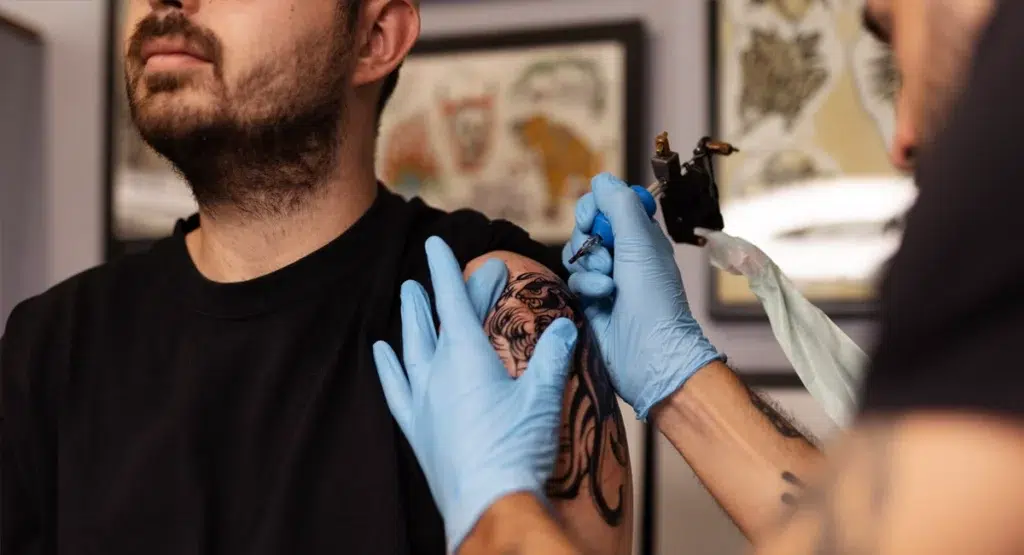
If these considerations are applied to other ‘cosmetic procedures’, it becomes clear that liability must be accepted in the case of cosmetic surgery or other voluntary interventions affecting the physical integrity of employees. This applies even if the employees cannot foresee the complications. Therefore, if an employee undergoes an unnecessary procedure for cosmetic purposes, they generally bear the risk of liability with regard to continued payment of wages.
Who bears the burden of proof?
In the event of incapacity for work, it is up to the employee to prove that they are not at fault for the incapacity. As a rule, submitting a medical certificate or obtaining an e-AU certificate is sufficient for this purpose.
As the certificate of incapacity for work does not specify a reason for the incapacity, the employer must have certain grounds for suspicion that suggest the incapacity is the employee’s fault. If the employer is aware of circumstances suggesting that the incapacity for work is linked to events occurring outside working hours – for example, because the employee has mentioned this or posted about it on social media – it is reasonable to assume that the incapacity for work is the employee’s fault. Consequently, the employee must then prove that they are not at fault.
Can an employer prohibit dangerous sports and cosmetic procedures in an employment contract?
A blanket contractual prohibition in an employment contract preventing employees from participating in certain sports or undergoing non-medically indicated procedures on their bodies would likely contravene the law governing standard terms and conditions and infringe upon employees’ right to self-determination. Employees’ opportunities for personal development in their free time should not, in principle, be restricted or even ruled out. In this respect, this would likely constitute unfair discrimination. A contractual exclusion is therefore unlikely to be valid.
Conclusion:
Employers are responsible for covering the standard risk of illness. This generally includes sports injuries, but not complications arising from tattoos, piercings or cosmetic surgery.
If there is substantial evidence to suggest that the employee may be at fault, the employer should initially withhold continued pay until the employee provides proof that they are not at fault.