
The EU Pay Transparency Directive is one of the most significant regulatory changes for employers in the coming years. The directive brings greater focus to an issue that is already a concern for many companies: fair, transparent and non-discriminatory pay. The aim of the directive is to reduce gender pay gaps and create greater transparency regarding how salaries are determined.
For employers, this means that remuneration structures must in future be documented, justified and evaluated even more clearly. This is not just about individual salary figures, but about a structured understanding of roles, requirements, pay bands, reference groups and possible deviations.
The EU Directive must be transposed into national law by Member States by 7 June 2026. For Germany, no final implementing legislation has yet been adopted. Nevertheless, it is already clear that requirements relating to rights to information, reporting obligations, transparent remuneration structures and comprehensible reference groups will become significantly more important.
What is the Pay Transparency Directive?
The Pay Transparency Directive is an EU directive designed to promote equal pay and pay transparency. Its aim is to highlight gender-based pay gaps and ensure equal pay for equal work or work of equal value. In future, companies will be required to provide more detailed documentation of how pay is determined, establish reference groups and comply with specific reporting requirements.
What the Pay Transparency Directive changes
The directive is intended to give employees greater insight into pay structures and place a stronger obligation on companies to explain pay differences. Key points include, amongst others:
- In future, employers must provide information on starting pay or a salary range as early as the application stage.
- Employees will have extended rights to receive information about their pay level in comparison with those performing the same or equivalent work.
- In addition, companies above a certain size will be required to report regularly on gender-specific pay differences.
The question of how comparison groups are formed will be particularly important. This is because salary differences can only be analysed and justified transparently if job roles, job requirements and pay structures are clearly defined.
For companies, the Pay Transparency Directive means that salary transparency must be better documented and made more traceable in future. This includes extended rights to information for employees, as well as new reporting obligations regarding gender-based pay gaps.
Key points of the Pay Transparency Directive
Application process
Provide information on the starting salary or salary range.
Employees
Extended rights to receive information about their pay levels.
Reporting requirements
Report regularly on genderspecific pay gaps.
Comparison groups
Clearly describe the duties, job requirements and pay structures.

Why companies should start preparing for the Pay Transparency Directive now
The EU Directive was due to be transposed into national law by 7 June 2026; however, no final implementing legislation has yet been adopted in Germany. Germany is therefore currently behind schedule in transposing European requirements. In such cases, the European Commission may initiate infringement proceedings, which could lead to financial penalties.
Pay Transparency Directive: How Rexx Systems supports implementation
Rexx Systems is developing targeted enhancements to Rexx HR to help companies meet the upcoming requirements regarding pay transparency. The focus is particularly on the areas of benefits, pay scales and the data warehouse. The aim is to make existing remuneration information even more structured and usable. This includes specific payment data on an employee-by-employee basis, the storage of pay groups and grades, as well as enhanced reporting options. This enables companies not only to manage their pay structures, but also to systematically analyse them and use them to form comparison groups.
Expanded pay scales with clear job criteria
A key component is the expansion of the pay scales to include so-called job criteria. These are neutral and transparent criteria that can be used to describe and evaluate tasks and roles. Examples of such criteria include responsibility, qualifications, professional experience, span of control, complexity, specialisation and market requirements. These criteria can be assigned specific selection values and stored as a set of criteria for groups and levels within a pay type. This creates a structured profile for each group or level. This profile can later serve as a basis for forming comparable groups in a transparent manner and making remuneration decisions more transparent.Create structured comparison groups
The creation of reference groups plays a key role in the implementation of the Pay Transparency Directive. Rexx HR will support two main methods for creating reference groups.Bottom-up approach to peer groups
In the bottom-up approach, reference groups are formed on the basis of existing salary data for individual roles, qualifications and performance levels. Criteria for forming these reference groups include, for example, similar duties and comparable requirements.Top-down approach for comparison groups
In the top-down approach, the formation of comparison groups is based more closely on the organisational structure, in particular on the job classifications within a role and the grading of employees in those roles. This enables companies to map the comparability of jobs more systematically. At the same time, the underlying criteria and their specific characteristics remain transparent and traceable.Create structured comparison groups
Comparison groups based on existing salary data for individual roles, qualifications and performance levels.
Forming comparison groups more in line with the organisational structure.
Gender Pay Gap: Reporting and Key Performance Indicators in the Rexx Data Warehouse
The Pay Transparency Directive makes analysing the gender pay gap significantly more important. Companies must be able to demonstrate whether their pay structures are in line with the objectives of equal pay and gender-neutral remuneration. The requirements of the Pay Transparency Directive make robust analyses and key performance indicators increasingly important.Evaluate remuneration structures using data
Reporting also plays a key role in pay transparency. The Rexx Data Warehouse is designed to provide additional key performance indicators and analyses that companies can use to analyse their remuneration structures.Compare market salaries and salary discrepancies
Planned features include average salaries, salary trends, analyses of groups and grades, and potential analyses of gender pay gaps. Support for market salary comparisons is also planned. This will provide HR departments with a better basis for reviewing remuneration structures using data, identifying trends and evaluating potential discrepancies in a well-founded manner.Reporting and key performance indicators
The Pay Transparency Directive in recruitment: greater transparency regarding salaries
These upcoming requirements will also have an impact on recruitment. In future, salary bands derived from benchmark groups, as well as market salaries, can also be used during the application process. This will make remuneration ranges more transparent at an early stage and make application processes more transparent.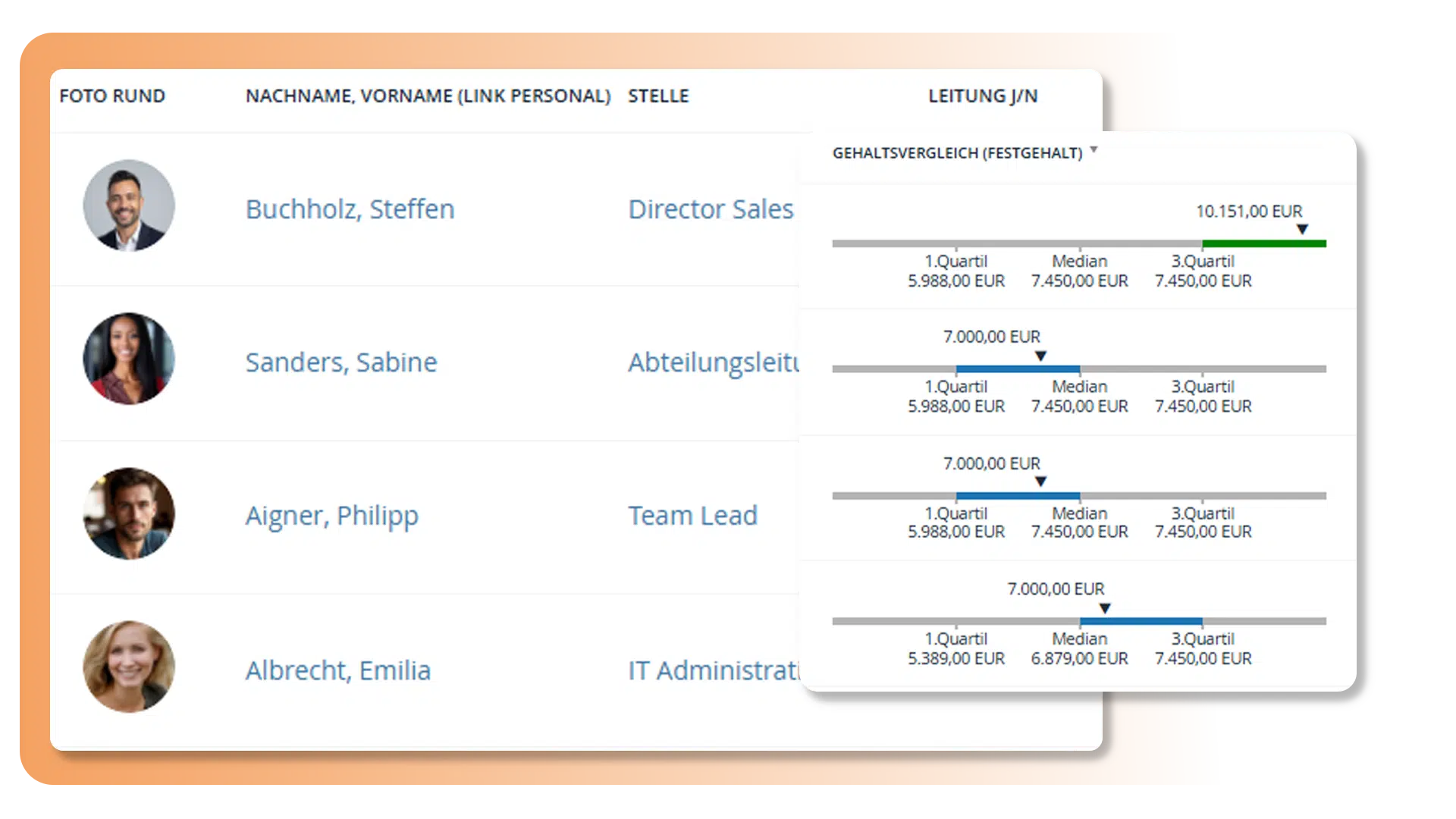
Pay Transparency Directive 2026: Setting the course now
No final implementing legislation has yet been adopted for Germany. Nevertheless, it is already clear that requirements relating in particular to transparent remuneration structures, benchmark groups, rights to information, and reporting and documentation obligations will be significantly expanded. Companies should therefore use this time to review their existing remuneration structures at an early stage and lay the organisational and technical foundations for greater transparency.
Rexx Systems is continuing to develop the relevant functions at an early stage to provide companies with the best possible support for organisational and technical implementation. As soon as development is finalised, further information on system requirements, modules and functions will be made available.


